
How to Build a Website That Sells for Excavation & Septic Pros
This chapter is about more than just “having a website.” We are going to cover the technical details as they relate to SEO (Search Engine Optimization), Google Maps, and Pay-Per-Click (PPC) marketing. However, here is the hard truth:
Your website is the engine of your entire marketing machine.
Without a properly designed and functioning website, your SEO and ad spend will be wasted. At Groundbreaker Marketing, we see this mistake constantly when auditing contractor websites: owners spend thousands of dollars driving traffic to a site that looks like it hasn’t been updated since 2005. Before you spend a dime on ads, your foundation must be solid.
Why Your Website Determines Your Cost-Per-Lead
Because Google uses a “Quality Score” to determine how much you pay for a click. If your website is slow, confusing, or doesn’t match what the user searched for, Google will actually charge you more for every click.
Why Google Ads fail without conversion optimization: If you spend $1,000 to get 100 people to your site, and your site is hard to use, you might only get 2 calls ($500/lead). If your site is optimized for conversion, you might get 10 calls ($100/lead). Your website is the difference between a profitable season and a massive waste of money.
Formats
- When it comes to websites, there are two basic options most websites are built with. They each have their pros and cons. Template Based Site Builders – These websites from companies like Wix, SquareSpace, and GoDaddy were designed for business owners on a budget to DIY and create themselves. Marketing companies sometimes use these drag-and-drop templated websites because they are easy and quick to build, and allow the business owners to make simple edits of their own down the road. The downside is that they often look less professional, lack customization options, and only have a fraction of the SEO tools and options available to them.
- CMS Systems – Content Management Systems, like WordPress, Joomla, and Drupal are the most popular options. CMS systems take significantly more expertise to build, edit, and maintain, but they often look much more professional, and have a large suite of tools for SEO, content management, and publishing.
The Dirt Work Website Blueprint: Layouts That Work
Excavation, septic, and dirt work companies need a different layout than a generic house painter or plumber. You are selling high-ticket, high-trust services. Your website’s job is to be clear, build trust, minimize risk, address common objections, and make it easy for your customer.
The Most Valuable Real Estate on Your Website:
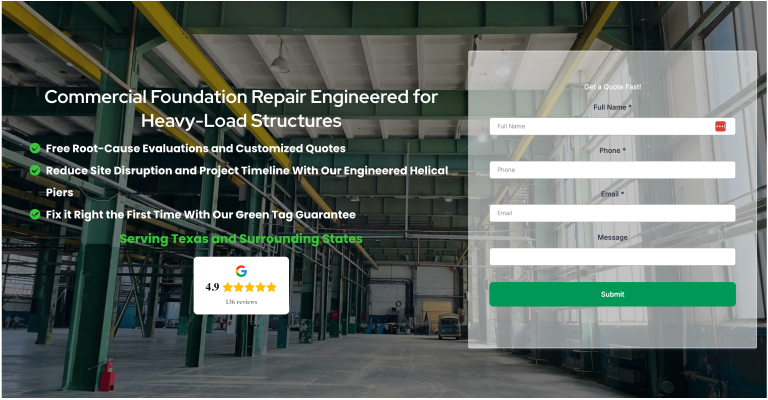
- The only place on your website you can guarantee a visitor will see, is the header, or everything that can be seen on a smart phone before you scroll. This is your most valuable website asset and it has a specific job to do. Here’s what you need in your header:
1. What You Do in 3 Seconds
A visitor should know exactly what you do within three seconds of landing on your site. Don’t just put “John’s Construction” in the header, or tell your whole life’s story. Use: “Professional Septic Installation & Inspection in [Your Area].” The goal is not to be cute or catchy, but clear. Use a recognizable industry photo (preferably a professional photo of your own) in the background of the header for quick visual recognition that your visitor is in the right place.
2. The Primary Call to Action (CTA)
Put your phone number in the upper right-hand corner on every single page. Make it “click-to-call” so mobile users can dial with one tap. For site prep, people often have emergencies or are ready for a bid. Don’t make them hunt for your phone number. You can also optionally place a form in the right half of the header image.
3. Solve Their Problem
Use three bullet points in the header to show how you uniquely solve their problem, reduce their risk, and make it easy for them. Use as few words as possible to get the point across.
4. Build Authority and Establish Trust
Display your Google Reviews count or badge in the header. If you have industry memberships, are part of the BBB, or have strategic partnerships that will be recognizable to your customer, you can place these just below the header, but still above the fold before a customer has to scroll.
To dominate your local market, your website shouldn’t just be a “digital brochure.” It needs to be built like a tree: a strong trunk (Home Page) with specific branches (Service, Area, Project, and Educational Pages) that catch different types of search traffic.
If you lump “Excavation, Hydromulching, and Grading” all on one page, Google won’t know which to focus on, and you won’t rank for any of them.
The Groundbreaker Website Architecture Map
This is the exact structure we recommend to ensure Google understands your expertise and your Ads have a high “Quality Score.”
1. The Home Page (The “Trunk”)
- Goal: Clarity of the clients problem and your solution, establish trust and authority, and direct traffic.
- Key Elements: Your main USP (Unique Selling Proposition), a “Get a Quote” form, and links to your top 3 services.
2. Service “Silo” Pages (The “Branches”)
Each of these must be a standalone page with 500+ words of content. You should have a page for each unique service you offer. Here are some examples:
Excavation & Earthmoving:
- General Grading
- Lot Clearing
- Pad Prep
- Hydromulching
- Forestry Mulching
- Driveway and Road construction
Septic System Services:
- Septic Installation
- Septic Repair
- Septic Inspection
- Septic Maintenance
- Septic Pumping
- Septic System Location
3. The “Service Area” Silo (The “Roots”)
-
Main Service Area Page: A map showing your 50-mile radius or regional service area.
-
City-Specific Landing Pages: * Example: yourwebsite.com/excavation-in-city-a
-
Example: yourwebsite.com/septic-repair-in-city-b
-
Why? This allows you to show up in the “organic” results below the Map Pack for towns you aren’t physically located in.
- The Educational Blog (The “Groundwater”)
This can become one of the major sources of traffic feeding into the rest of your website. An educational blog not only showcases your expertise, but is the perfect fuel for keyword ranking and organic search traffic.
- Every article you write is like a line in the water ready to catch the next bid.
5. Trust & Utility Pages (The “Leaves”)
- Our Equipment: A gallery of your fleet. (This proves you aren’t just a “guy with a shovel.”)
- Project Gallery: High-res photos of finished jobs. This is good for potential customers who are trying to decide if they should work with you.
- Reviews/Testimonials: Direct feeds from Google and Facebook.
- Careers: An easy application form for operators and laborers.
- Contact Us: Your phone number, and a simple form for those who are searching for a solution outside of your open hours.
Why Excavation Sites Need “Real” Content
- Authentic Images: Stop using stock photos of a clean guy in a hard hat. Show your iron in the dirt. Show your team at the job site. Authentic imagery converts 10 to 1 over generic stock photos because it builds immediate trust.
- The “Before and After” Gallery: For dirt work, seeing the transformation from a wooded lot to a pad-ready site is your best sales tool.
- Equipment Showcase: Contractors often overlook this, but showing your fleet (backhoes, dozers, dump trucks) proves you have the capacity to handle the job.
Why This Map Wins You Jobs
When a homeowner searches “Septic repair near me,” Google wants to show them a page specifically about septic repair—not a general construction homepage. By having a dedicated page for every service, you:
- Lower your Ad costs: Google sees your landing page is highly relevant to the search.
- Increase Trust: The customer sees exactly what they were looking for immediately.
- Dominate More Keywords: You start “collecting” rankings for dozens of different terms instead of just one.
When we audit sites that aren’t getting calls, 90% of the time it’s because they have one giant ‘Services’ page. You can’t win a specific race with a general-purpose vehicle. You need a dedicated page for every high-value job you want to win.
The Psychology of the Click: Moving the Dirt
Most contractors view their website as a digital business card. But in the world of high-stakes site prep and septic work, your website is actually a trust-building machine. When a customer lands on your page, they are usually feeling one of two things: Stress (my septic is backing up) or Uncertainty (I’m about to spend $20k on a house pad and don’t want to get ripped off).
To get the “click,” you have to solve those feelings immediately. Here is the Groundbreaker psychology for converting visitors into high-value leads:
1. It’s Not About You
Don’t just tell them what you do; tell them you understand their problem. If a homeowner is looking for septic repair, they are likely frustrated and worried about the cost.
- The Old Way: “We fix septic tanks. Call for a bid.”
- The Groundbreaker Way: “A septic failure is a nightmare for your family. We provide fast, honest repairs to get your life back to normal.” By addressing the emotional pain point, you move from being a “vendor” to being a “solution.”
2. Catering to the Two “Lead Modalities”
People search for services in two different mental states, and your website must serve both simultaneously:
- The “Now” Modality (The Call): This person has an emergency or is ready to book. They want a phone number in the top right corner that they can tap with their thumb.
- The “Later” Modality (The Form): This person is at work, or it’s 10:00 PM, or they are just in the “gathering info” phase. They don’t want to talk to a salesman yet. For them, a Lead Capture Form “above the fold” (visible without scrolling) is mandatory. If you don’t have a form, you are losing 30–40% of your potential leads.
3. The “Auditory vs. Visual” Connection
Some people want to read your specs; others want to hear your voice. This is why Video is the ultimate conversion tool for dirt work. A 60-second video of you standing in front of your excavator does three things:
- It proves you have the equipment you claim to have.
- It lets them “meet” you before you step onto their property.
- It builds an audible connection that text can’t match.
4. External Proof (The “Safety in Numbers” Principle)
Human beings are “socially driven.” We want to know that other people have hired you and didn’t regret it. Don’t just copy and paste text testimonials; they look fake. Use a widget that pulls in live Google Maps Reviews with the star ratings and the reviewer’s photo. When a customer sees 50 other people in their town giving you 5 stars, the “buying barrier” drops instantly.
If your website is only a list of your services, you’re a commodity. If your website addresses the customer’s pain, offers multiple ways to connect, and proves your reputation through video and live reviews, you’re the authority. Authorities get to charge more and stay busier.
Mobile is Not Optional: The Field-Ready Website
In the dirt world, your customers aren’t always sitting in an office chair when they look for you. They are often homeowners standing over a leaking septic tank, or builders on a job site needing a pad cleared immediately. If your website doesn’t work perfectly in their hand, you’ve lost the job before you even had a chance to bid.
Consider these eye-opening facts:
- 70% of web traffic now happens on a mobile device.
- 40% of mobile users are specifically looking for a local business “near me.”
- 57% of users say they wouldn’t recommend a company if their mobile website design is poor.
- 61% of users will have a more positive opinion of your business if you have a high-speed, responsive mobile site.
The Groundbreaker Rule: If your website doesn’t work perfectly on a mobile phone, you aren’t ready to run Google Ads. You are essentially pouring diesel on the ground.
How to Audit Your Mobile Presence (and Your Competitors’)
To become the local authority, you need to know who you’re up against. Pull out your smartphone right now and perform a “Service + Your City” search.
- Speed Test: Click on your website and a competitor’s. Does yours load in under three seconds? In the mobile world, every second of “loading” time feels like an hour.
- The “Thumb” Test: Can you find the phone number and “Request a Quote” button immediately with your thumb? If you have to pinch, zoom, or hunt for a contact page, your customer will hit the “Back” button and call the next guy.
- Basic Info Only: Mobile users are looking for the “Big Four”: Who you are, what you do, where you are, and how to contact you. They don’t want to read a 2,000-word history of your company on a 6-inch screen. Keep it lean and punchy.
How to Win Jobs
Getting a steady flow of leads every week is a beautiful thing, but with 9 out of every 10 contractors I work with, there is a breakdown from getting the lead to booking the job. Because we track every form and phone call for our clients, and have a team member scoring those leads and making notes each week, we have a very clear picture of what happens on the phone calls our clients receive.
It’s a privilege to partner with those companies and educate the owners on simple, practical ways they can improve their phone and email process to make the most of their advertising. Many times they will double their ROI just by making some simple changes.
Here’s what works on the field in the real world:
- Set up a custom voice message. When you miss a call, you need to let the potential customer know that they’ve called the right place, you can help them, and you will get back to them soon. Do not use a generic message, “hey this is “your name” leave a message”, or a google spam filter message. If they hear one of those they will think they’ve called the wrong number, hang up and call the next company on the list. We have heard it happen in real time on recorded calls more times than we can count. You are a professional, and your business should have a professional message. The worst case we encountered was a septic company who had no voice message set up, and weren’t receiving their website forms at all. They had no idea until we set up our tracking system on their calls and forms.
- Solve the customer’s problem in the first phone call or as quickly as possible. We had a contractor who’s wife answered the phone and took the customer’s information, and sent it to her husband to get back to them when he got around to it, sometimes days later. That company had an unusually low close rate of leads to booked jobs. Once we had them change their process and the wife started booking estimates on the first phone call, their close rate and profits increased. People get tired of waiting, and when the competition is faster, they win.
- When many people own it, no one does. We use this concept in our own agency. When you have many people responsible for a task, no one really owns it and follows through. I understand your team and operations are complex and constantly changing and at the mercy of your job schedule. I’ve physically sat in those team meetings with companies as they vigorously debate how to handle answering the phones, estimating and bidding, and managing job site work. I know it’s not easy but you must assign someone to the phones, and someone to sales and estimation to follow through. I have watched companies figure this piece out, and grow by millions of dollars annually.
- Follow up fast on website forms. Create your website form to require a name, phone number, and request at a minimum. Have a system in place to respond by a phone call within a few hours. You will win hundreds of thousands worth of jobs by making this a priority. Speed is king! We like to set up text alerts on webforms for our clients so they never miss a beat.
When you pair great PPC strategy with a high converting website, and killer follow up, you will be in a category your competitors can’t touch.
Last updated:
Want your phone ringing like the operators in these interviews?
We run Local Service Ads, Google Ads, Google Business Profile and websites for septic and home-service contractors — with every lead tracked.